Shipwreck
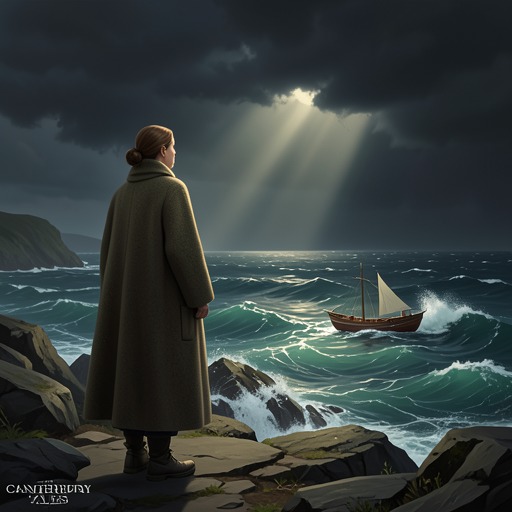
The Canterbury TalesShipwreck in the narrative names more than a vessel’s collision with the shore. It is the condition in which Constance, separated from human protection and political belonging, is repeatedly delivered to an unknown coast with her life and faith reduced to their barest essentials. The sea makes exile visible: it carries her away from Syria, deprives her of companions, prolongs her uncertainty, and finally casts her beneath a heathen castle in Northumberland. Yet the same drift that seems to promise death becomes the instrument through which she reaches Italy’s Christian world and continues the story of endurance, providence, and return.
Causes and Background
The first shipwreck-like crisis follows the collapse of Constance’s marriage arrangement and the violent destruction of the court around her. The day fixed for departure arrives as a “woeful, fateful day,” and nothing can delay the beginning of the journey. Constance is brought to the ship with ceremony, but the formal dignity of the departure cannot conceal how exposed she has become. Her prayer, “Now Jesus Christ be with you all,” marks the contrast between public ritual and private danger: she is sent away under religious words, but into a future no human institution can secure.
The political violence soon makes her maritime exile literal. Those who had supported the Sultan’s counsel are killed before they can escape, and Constance is placed aboard a ship “without a crew.” The command that she learn to sail from Syria back home to Italy is therefore an impossible burden rather than practical instruction. She is not merely traveling across a known route; she is being removed from the social world that could navigate, defend, or receive her. The ship becomes a floating form of imprisonment, carrying a woman and her child without a pilot toward an unknowable destination.
The Course of Exile
Constance remains afloat for days and years, crossing the Sea of Greece and reaching the Strait of Morocco. The duration is crucial. Shipwreck here is not exhausted by the first impact against land; it is an extended suspension in which ordinary measures of time, safety, and home lose their force. The narrative gives the voyage the scale of a life placed on hold, with no crew, reliable course, or assured arrival to interrupt the uncertainty.
Her physical deprivation makes the condition concrete. She eats many sorry meals, and she frequently expects death before the wild waves can carry her to the place where she longs to arrive. Hunger and fear are not ornamental signs of suffering but the daily terms of her survival. Her body becomes the measure of the voyage’s violence: each meal is inadequate, each delay intensifies danger, and every prospect of land remains inseparable from the possibility that the sea will kill her first.
The sea also repeatedly defeats human plans. Constance is driven onward without aim until the waves cast her vessel beneath a castle whose name the narrator cannot supply. The ship strikes fast in the sand and cannot be moved against the tide. Its immobility changes drift into forced residence: she has not reached a chosen harbor, yet the will of Christ is presented as making that place the one where she must abide. The wreck is therefore both ruin and provisional refuge, a material stoppage that the religious narrative interprets as providential direction.
The Wreck and the Shore
At Northumberland, the stranded vessel attracts the castle’s constable, who hurries to inspect the wreck and search for survivors. He finds Constance, weary and full of care. This moment converts an anonymous maritime disaster into a scene of recognition. Until then, the sea has rendered her nearly unreachable; the constable’s arrival creates the first possibility that another human being might witness her condition and respond to it.
The later account repeats the pattern on an even more desperate scale. After being forlorn for five years or more, Constance’s ship approaches shore beneath a heathen castle whose name the narrator again admits is absent from the text. She and her child are cast up by the sea, and the narrator explicitly places them near the point of death. People come down from the castle to gaze upon the ship and Constance, so the wreck becomes a public spectacle as well as a crisis of survival. The castaways are visible to others, but visibility does not immediately equal safety; their fate still depends on what the inhabitants will do.
This recurrence gives the event a structural force. Constance is not shipwrecked once and then simply rescued. The narrative returns her to the same elemental arrangement—sea, unknown coast, foreign castle, exhausted mother, endangered child—so that each landing feels like both repetition and a new test. The delay between the wreck and any secure home keeps survival provisional and makes deliverance appear as something granted rather than possessed.
Consequences and Meaning
Shipwreck strips away rank, household, nationality, and political protection. Constance begins as a fair maid sent away through a formal marriage transaction, but the sea reduces that social identity to a solitary responsibility for life and faith. Her repeated casting-up on foreign shores makes exile an embodied condition: she must endure displacement not as an abstract political sentence but through hunger, exposure, uncertainty, and the constant expectation of death.
At the same time, the narrative refuses to treat the sea as sovereign. Waves drive her without aim, tides hold the vessel fast, and unnamed shores prevent her from mastering the geography of her own story; nevertheless, the narrator repeatedly frames these accidents within Christ’s will. The wreck’s apparent randomness is thus placed beside providential purpose. Human violence creates the exile, nature prolongs it, and divine care keeps Constance and her child from disappearing into the disaster.
The event’s deepest significance lies in that tension between abandonment and preservation. Shipwreck is the visible form of Constance’s being cast into an existence she did not choose, but it also carries her toward encounters that would be impossible within the protected world she has lost. Its narrative movement runs from ceremony to slaughter, from a crewless ship to years of drift, from hunger and anticipated death to a shore where witnesses finally appear. The wreck therefore functions as both catastrophe and passage: it destroys the conditions of ordinary belonging while preserving the protagonist for a future return.